
Start a Corona Resident Search
The best first move is to sort the question by record type. A street clue belongs with a parcel and GIS search. A past household belongs with directories, newspapers, deeds, and census pages. A current name may lead through a business filing, a court index, a professional license, or an authenticated voter-status check. Riverside County ACR combines assessor, recorder, and county-clerk functions, while the Corona City Clerk handles municipal records. The Riverside Superior Court keeps case files. The Corona Public Library holds a different kind of evidence: local history that can connect a name to a club, school, business, map, or neighborhood.
No single source is a complete resident list. A property record can show an owner, parcel, mailing address, and legal description, but it does not show renters or every household member. A voter tool is an identity-matched self-service check, not an open street list. A directory entry is a dated clue, not proof of today’s residence. Start with the most stable fact, save the record number or APN, and use a second source to test the first result.
- Use the Riverside property search or Map My County to turn a street address into an APN, situs address, and legal description.
- Search the ACR recorded-document index by party name, date, and document type, using the surname-first format when the portal calls for it.
- Use California My Voter Status only for an identity-matched self-lookup, or review the qualified-purpose file rules before seeking voter data.
- Check the Riverside court index, business and license records, or vital-copy channel when the question concerns one person or one event.
- For earlier residents, ask the Heritage Room for the right directory, microfilm, map, yearbook, or newspaper run, then compare the dated clue with a deed or obituary.
Where Corona Resident Records Live
Corona is an incorporated Riverside County city, not a separate county-records jurisdiction. The split matters. The City Clerk is the first stop for council, planning, permit, administrative, and municipal police records. Riverside County ACR keeps deeds, assessments, marriages, fictitious business names, and most county vital-copy channels. Superior Court files belong to Riverside County Superior Court. The California Department of Public Health is the state vital-record custodian. Sending a request to the wrong desk can turn a simple lookup into a dead end.
Riverside County ACR
Recorder, assessor, and county-clerk services
800-696-9144
951-486-7000
Corona City Clerk
400 S. Vicentia Avenue, Suite 115
Corona, CA 92882
951-736-2201
City records and California Public Records Act requests
Riverside Superior Court
Countywide case index, registers of action, and courthouse files
Corona Courthouse: 505 S. Buena Vista Avenue
Corona Public Library
650 S. Main Street
Corona, CA 92882
951-736-2381
W.D. Addison Heritage Room and local-history collections
Corona Property Search Starts With a Parcel
For a street or address question, begin with the Riverside County ACR Property Search. Its documented modes use a property address, APN, or Assessment/PIN. The online card can lead to the parcel number, situs address, legal description, property type, acreage, assessed land and improvement values, and transfer history. The owner name is deliberately not displayed online under the county’s current policy, so an online property result is not a complete owner directory. Public computers or office records can provide owner identity from an address or APN.
The Riverside property portal is most useful as a bridge. Once the parcel is known, search the recorded-document index for the named party, then compare the deed’s legal description with the parcel. Keep situs, mailing address, and legal description separate. Situs means the physical location. Mailing address tells where a tax notice goes. The legal description is the stable land identity when a street name or number changes.
| Portal field | Type | What it does | Limit |
|---|---|---|---|
| Property Address | Text | Finds a parcel from a street number and name | Normalize directionals and street suffixes |
| APN | Text | Finds the county assessment parcel | Use the digits shown by GIS or a tax record |
| Assessment/PIN | Text | Uses the county assessment identifier | Enter the first nine digits without the dash/check digit |
| Results | Parcel list | Opens a parcel card and related property details | Online owner identity is not displayed |
The office-level source behind the county property and clerk functions is shown in the Riverside ACR source capture.
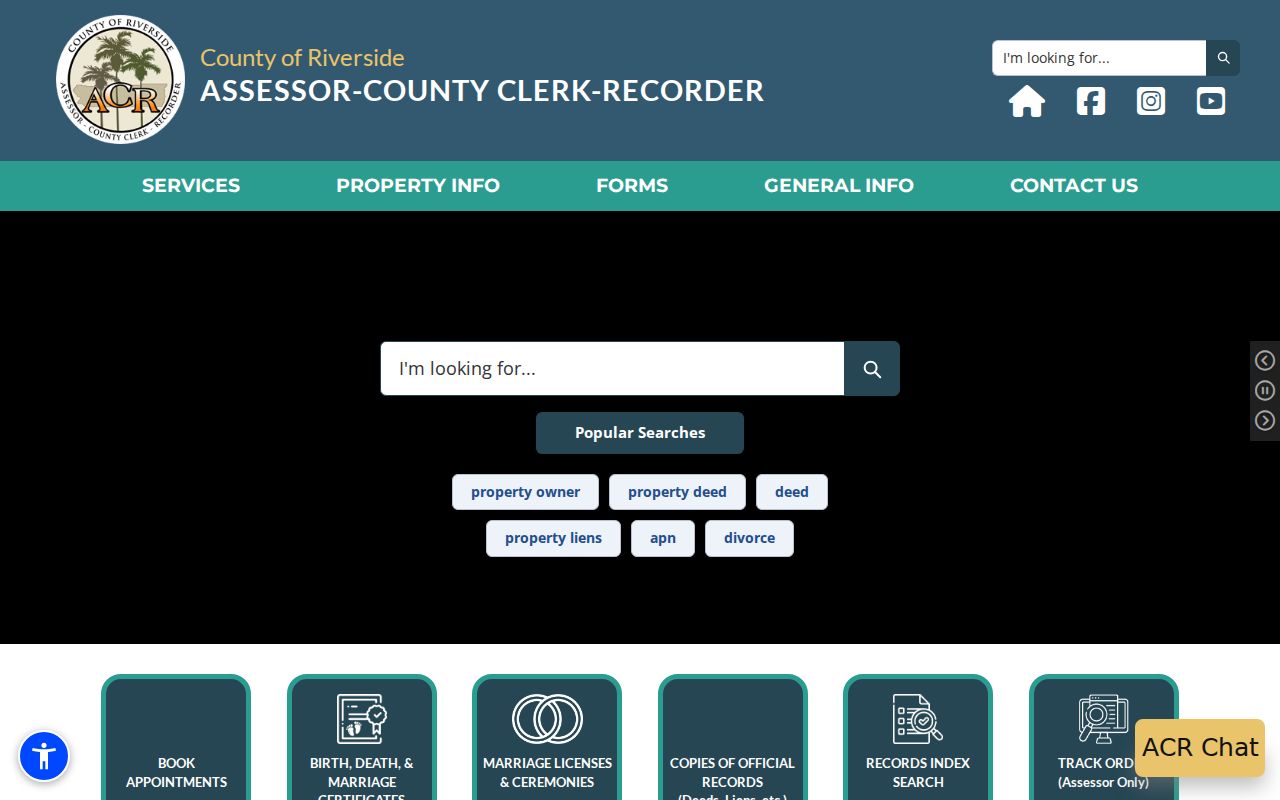
The county office is the custodian connection for parcel questions, recorded documents, and clerk records that do not belong to Corona City Hall.
- Parcel
- A county assessment unit identified by an APN, not a list of all people at an address.
- Situs address
- The physical property location, which may differ from the tax mailing address.
- Legal description
- The deed language that identifies the land by lot, subdivision, map, or metes and bounds.
- Index
- A finding aid for a recorded instrument; it is not the certified image or the full file.
Riverside’s 1974 Corona Deed Divide
The Riverside recorder’s web index begins on January 1, 1974. The county-clerk index reaches back to January 1, 1893, when Riverside County was formed. Those are different coverage lines. A search that stops at 1974 has not proved that an earlier deed is absent. For older land research, use the recorder counter, physical grantor-grantee books, microfilm, FamilySearch or library guidance. The Gateway Riverside office is the county’s stated location for 1974-and-earlier recorder work.
The recorder index accepts an individual name in LAST FIRST MI order without punctuation, while an organization should be searched as recorded. Exact mode preserves entered order. Advanced name searching can broaden variants with wildcard and sounds-like tools. A representative result identifies indexed parties and roles, recording date, document number, document type, and sometimes book/page references. It proves that an instrument was recorded, not that the person lived at the property or that every statement in the instrument is true.
For a copy, ACR lists $8 for the first page, $1 for each additional page of the same document, and $2 for certification. Online card orders add a 2.15% fee. In-office requests may be same day; mail searches without a document number ask for complete party names, title or type, estimated date, and parcel number. Mail requests for pre-1976 material are limited to two years after the estimated year, with a stated one-to-two-week turnaround.
Note: A no-result before 1974 is a prompt to change channels, not evidence that the property had no earlier owner.
For a visual example of the name, date, and document search, see the Riverside ACR document-search source.
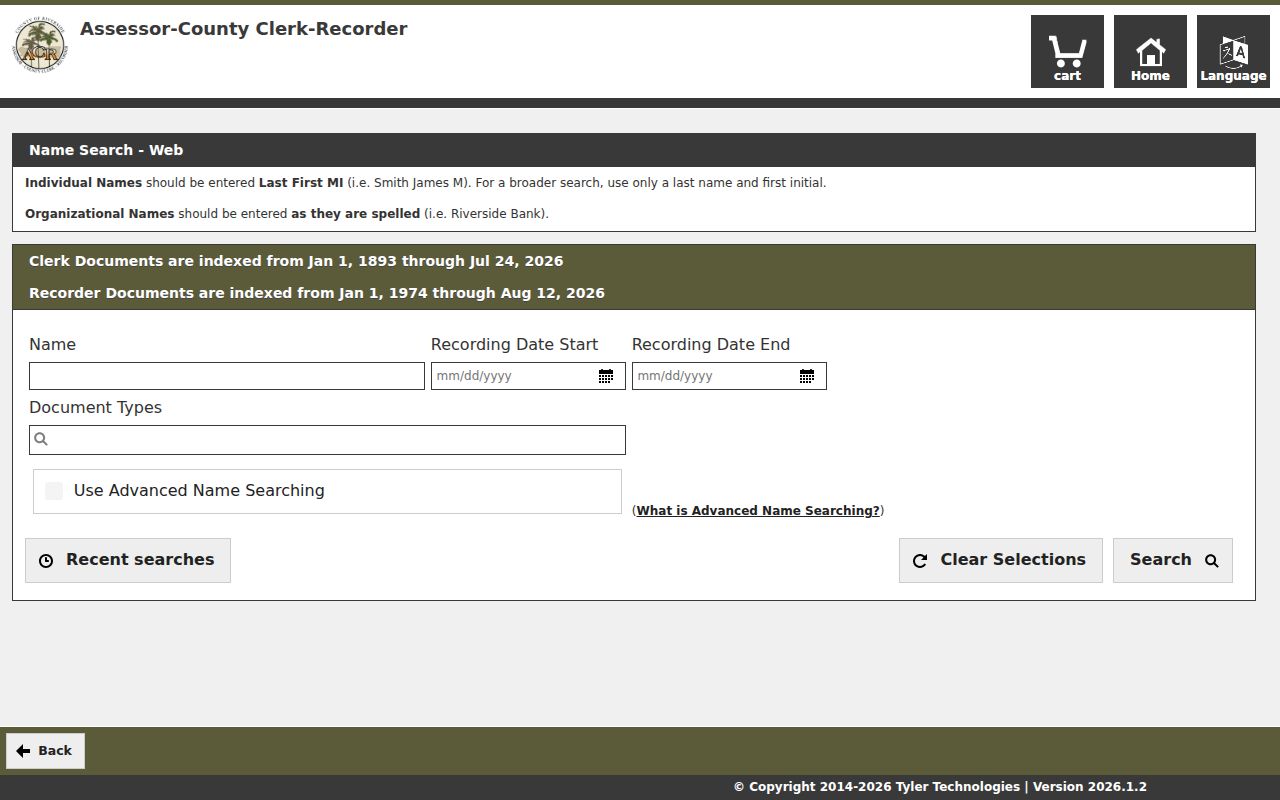
The capture shows the kind of index screen that starts a deed or lien trail. Use the resulting document number to request the official image or certified copy from ACR.
Current Resident Sources for Corona
Current resident clues are distributed across sources with different meanings. The county property roll identifies parcel and assessment information. The recorder ties names to instruments. A voter status result belongs to the person who completes the identity match. A city record may identify an applicant, owner, contractor, complainant, or responsible party rather than a resident. Business and professional-license records can connect a person to a public address of record. Treat the record’s role as carefully as the name.
| Source | What it can show | Keeper | Access |
|---|---|---|---|
| Property parcel | APN, situs, values, characteristics, and possible office-only owner identity | Riverside ACR | Address/APN search; informational |
| Recorded-document index | Parties, role, instrument type, date, and document number | Riverside ACR | Free index; copy fees apply |
| Voter status | Authenticated registration status, address, party, polling, and ballot details | California Secretary of State | Self-lookup only |
| Business or license record | Entity, license status, agent, filing address, or public discipline | State and city custodians | Public search; detail varies |
| City record | Permit, planning, police, council, or administrative participant | Corona City Clerk | Portal, counter, or request |
Each row answers a narrower question than “who lives here?” For a more focused name-to-record sequence, the resident lookup route is the natural next step. A street search should stay anchored to the parcel and then branch into the deed or address record that fits the purpose.
California Voter Lookup for Corona
California My Voter Status is a private self-service check. It asks for first name, last name, full date of birth, and either a California driver license or ID match, the last four Social Security number digits, or the applicable no-identifier choice. A successful match can return registration status and address, party preference, language preference, polling place, upcoming-election information, ballot status, and county contact information.
The tool is not a public name directory and it is not a by-street browse. Qualified voter-file access is limited to election, scholarly, journalistic, political, or governmental purposes. The statewide application lists a $100 fee, while a specific voter request is $30 each with the stated maximums. California Elections Code §§ 2188 and 2194, related regulations, and the application attestations control the file. Confidential voters and protected identifiers are suppressed.
- Identity fields
- First name, last name, full date of birth, and a qualifying ID or last-four SSN path.
- Self-lookup output
- Status, registration address, party preference, polling place, ballot status, and county contact.
- Approved file fields
- Name, DOB, registration date, address, precinct, contact information, and party preference, subject to law.
- Excluded identifiers
- Driver license or state ID number, last-four SSN, unique identifier, signature image, and confidential records.
California My Voter Status confirms an authenticated user's registration details. It does not turn the Corona voter roll into an open resident directory.
The identity step is visible in the California My Voter Status source capture.
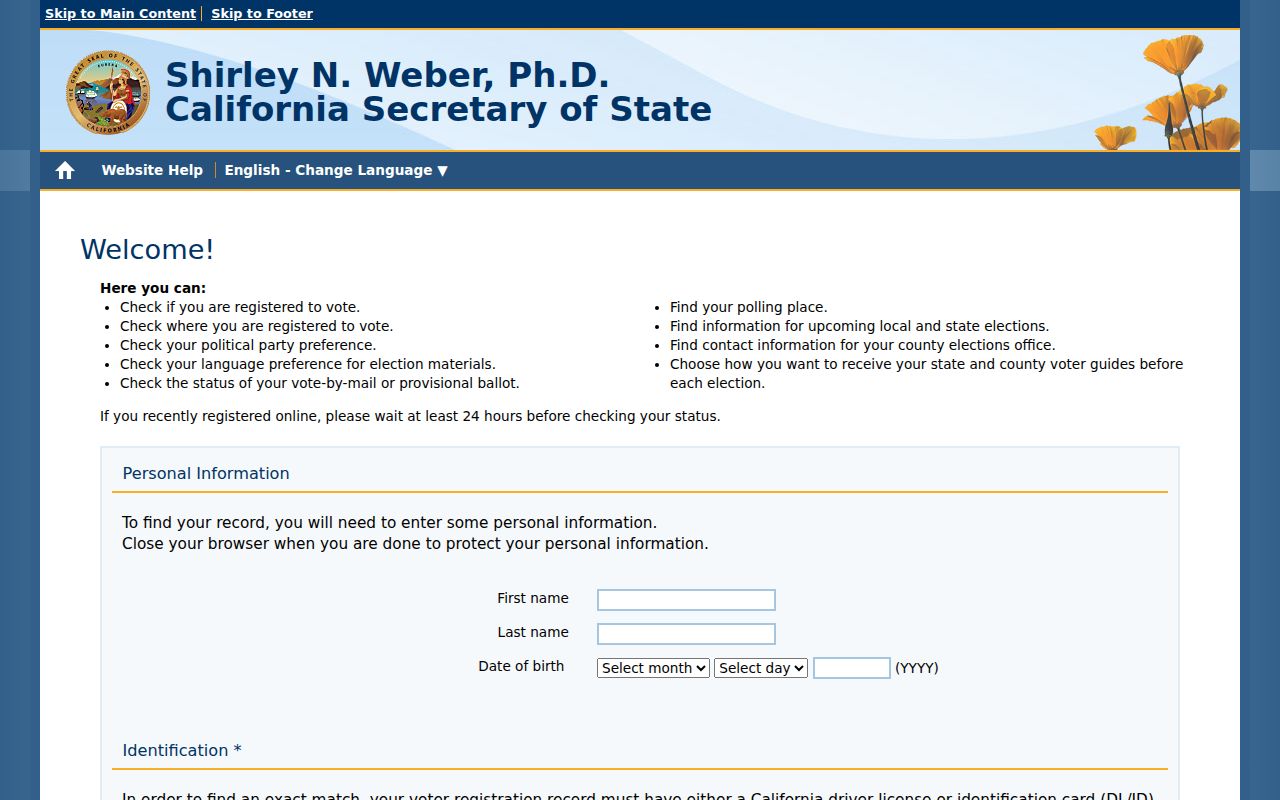
That form is designed for a person checking their own registration, which is why it should not be treated as a casual Corona name list.
Corona ZIP Geography Can Mislead
Corona’s mailing geography reaches beyond one clean city outline. The official GIS layer includes 92503, 92879, 92880, 92881, 92882, and 92883 Census ZCTAs, plus locally added 92878. ZIP 92877 is tied to the Citrus post office and has no Census polygon in that layer. The far-south 92883 mailing geography includes Temescal Valley addresses that may sit outside incorporated Corona. A postal label alone is not a jurisdiction test.
Use USPS to verify where mail is delivered, then use Riverside County GIS to check incorporated-city status. A property record may use a situs ZIP, a mailing ZIP, an APN, or a legal description. Those fields can disagree without an error. When a name search returns several nearby jurisdictions, compare the parcel and city boundary before asking Corona for a record that belongs to Riverside, Norco, or an unincorporated area.
- 92877
- Corona and Citrus post-office designation; it has no Census polygon in the reviewed layer, so verify delivery use with USPS.
- 92878 and 92879
- North, northwest, and east-central Corona areas that need parcel checks near Riverside and Norco edges.
- 92880
- West and northwest growth geography; older records may retain the ZIP after the 2020 delivery change.
- 92881 and 92882
- South, east, central, west, and southwest areas where parcel jurisdiction resolves close boundaries.
- 92883
- Far-south Corona postal geography and Temescal Valley, where a Corona mailing label may sit outside city limits.
For the mapped layer behind these distinctions, open Riverside Map My County and inspect the parcel rather than treating a ZIP as a resident list.
Riverside Court Records for a Corona Name
Corona cases principally run through the Superior Court of California, County of Riverside. The public portal has separate Index, Register of Actions, Calendar, Documents, and Probate Notes modes. A free account is required. A person or organization name search uses credits, while case-number searching and the Register of Actions are free. A court hit supplies a party name, role, case number, chronology, and sometimes disposition, but a same-name result is not identity proof.
Compare middle initial, city, age or date of birth where lawfully visible, business or parcel connections, and the timeline. A dismissal, acquittal, sealing status, or restricted case type changes what a result means. Corona civil coverage begins in March 1994 and small-claims coverage in November 1994; family and probate coverage have their own published ranges. The courthouse clerk remains the source for certified copies and older or restricted files.
- Index: person or organization name search, with one credit per search
- Register of Actions: case-number events and docket chronology
- Calendar: current and future hearings up to seven days
- Documents: case-number access where remote viewing is allowed, with fees or limits that vary
- Probate Notes: hearing notes posted on the court's timing schedule
Use the court result as one dated piece of a resident lookup. It does not replace a file request, and it does not establish that a party lived at the address in the caption.
Corona Vital Records and Copy Types
California vital records use a sharper access distinction than a simple public or closed label. An authorized certified copy can establish identity for an eligible requester who meets the statutory category and sworn-statement rules. An informational certified copy is marked not valid for identity and is available more broadly unless the record is confidential or sealed. Confidential marriage copies are limited to a party or a court order under Family Code § 509. Adoption and amended records have separate restrictions.
The CDPH vital-record application hub identifies the state channel, while Riverside ACR handles county events and local marriage records. Effective January 1, 2026, CDPH lists $31 for birth, $26 for death, $19 for marriage, and $18 for a dissolution certificate. Riverside ACR lists county birth at $34, death at $26, public marriage at $19, and confidential marriage at $19. A search fee can remain due when no record is found.
Application fields can include applicant contact details, registrant or decedent name, event date and place, parents’ names, relationship, purpose, copy type, signature, and a sworn eligibility statement. Use the county or state custodian for the event and copy type rather than expecting a complete current name index.
The state application hub also explains the forms and instructions before a copy request is mailed.
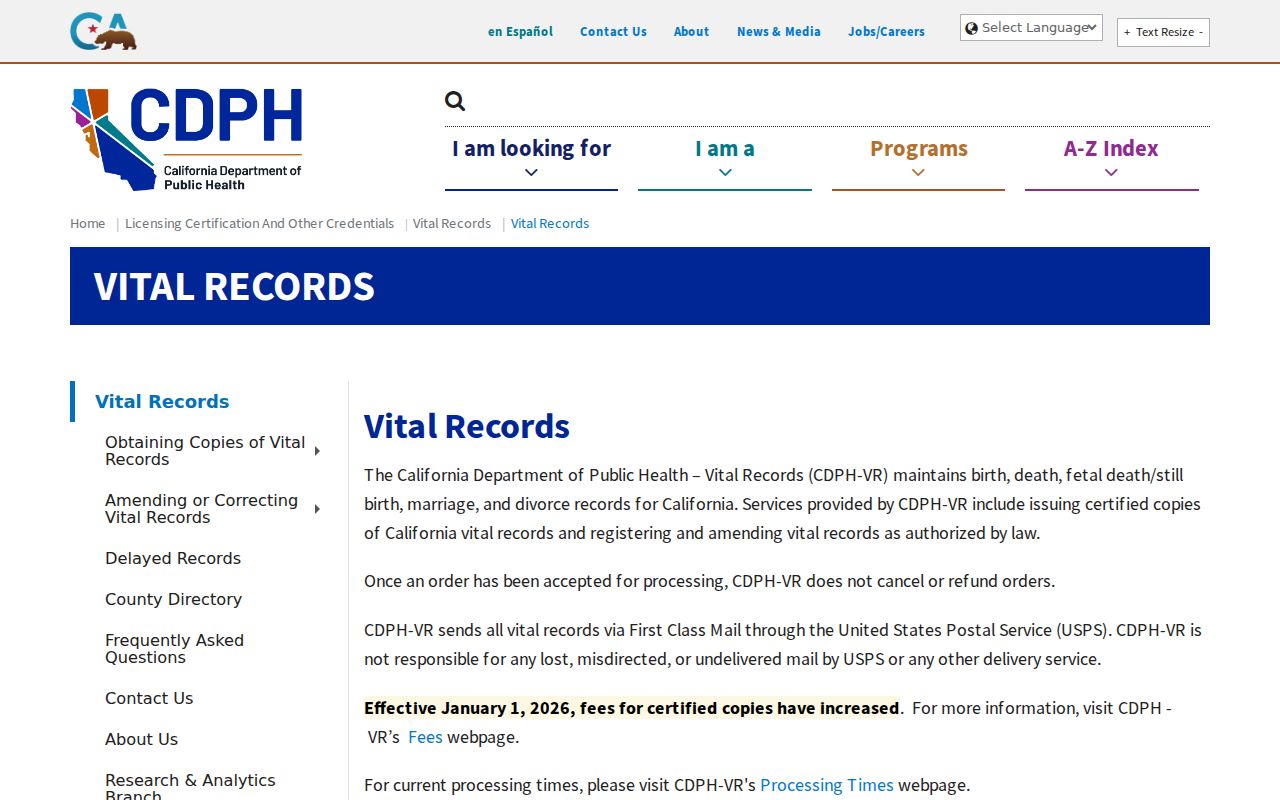
The application screen reinforces the key point: eligibility and copy type determine access, not an assumed age threshold for every California record.
Corona City Clerk Public Records
The Corona City Clerk keeps official city documents, council proceedings, municipal-code material, claims, campaign and FPPC filings, public notices, and the records-management program. The city’s CPRA portal separates City Records from Police Department and Animal Services requests. It also provides a knowledge base, a public request archive, and account tracking. Before filing, search the linked building, business-license, council, public-hearing, and Planning Commission resources.
A focused request names the department, date interval, address or APN, permit or case number, and desired electronic format. City records can identify an applicant, owner, contractor, complainant, or responsible party. They do not prove that a person occupied the property. Police reports can contain confidential complainant, victim, juvenile, or investigative details. Approved releasable traffic reports are listed at $0.25 per page, and a local verification or clearance letter is listed at $27.
Start at the Corona City Clerk public-records page when the record concerns city government. Marriage certificates, birth and death certificates, fictitious business names, and document recording are redirected to Riverside County ACR. Traffic, small claims, and criminal matters belong with Riverside Superior Court.
The city request page provides the entry point, archive, and tracking path for those municipal records.
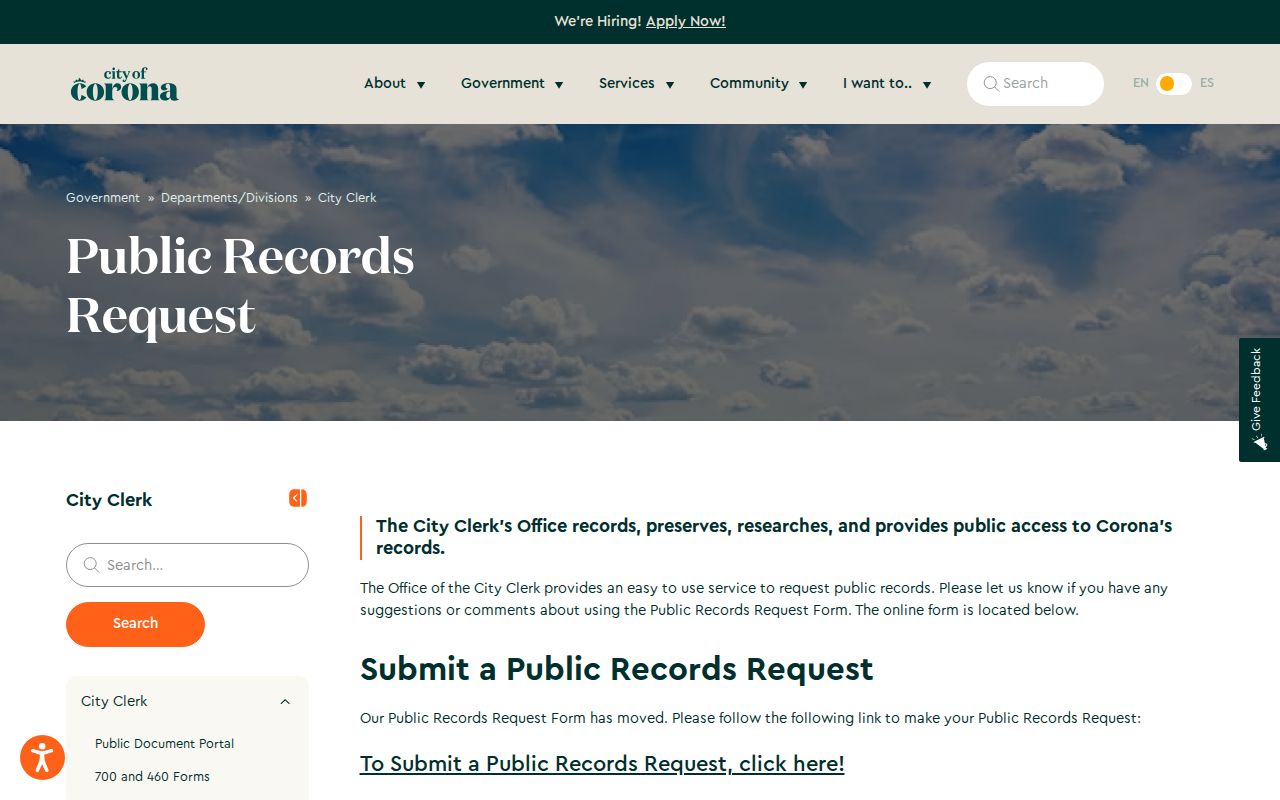
The city portal is a request and tracking channel, not a ready-made resident roll. Search the right department before asking staff to locate an existing record.
Corona Heritage Room Resident Clues
The W.D. Addison Heritage Room is the local bridge when a current database cannot explain an older name or address. Its holdings include photographs, slides, genealogies, books, manuscripts, yearbooks, maps, citrus labels, business and club records, church records, letters, diaries, ephemera, newspaper microfilm, and other Corona material. The room reports about 6,000 digitized items in Corona Heritage Online. Search by surname, street, business, school, subdivision, or organization, then ask staff about material that has not been digitized.
Room hours and retrieval rules matter. Some holdings are offsite, so request them before visiting. Closed-hour research appointments are available Tuesday through Thursday with at least one week’s notice. Staff permission is required for copying, scanning, and photography. The Memory Lab has a planetary scanner and microfilm, fiche, VHS, DVD, and reel-to-reel equipment; bring a flash drive and follow staff instruction.
See the W.D. Addison Heritage Room source before planning a visit.
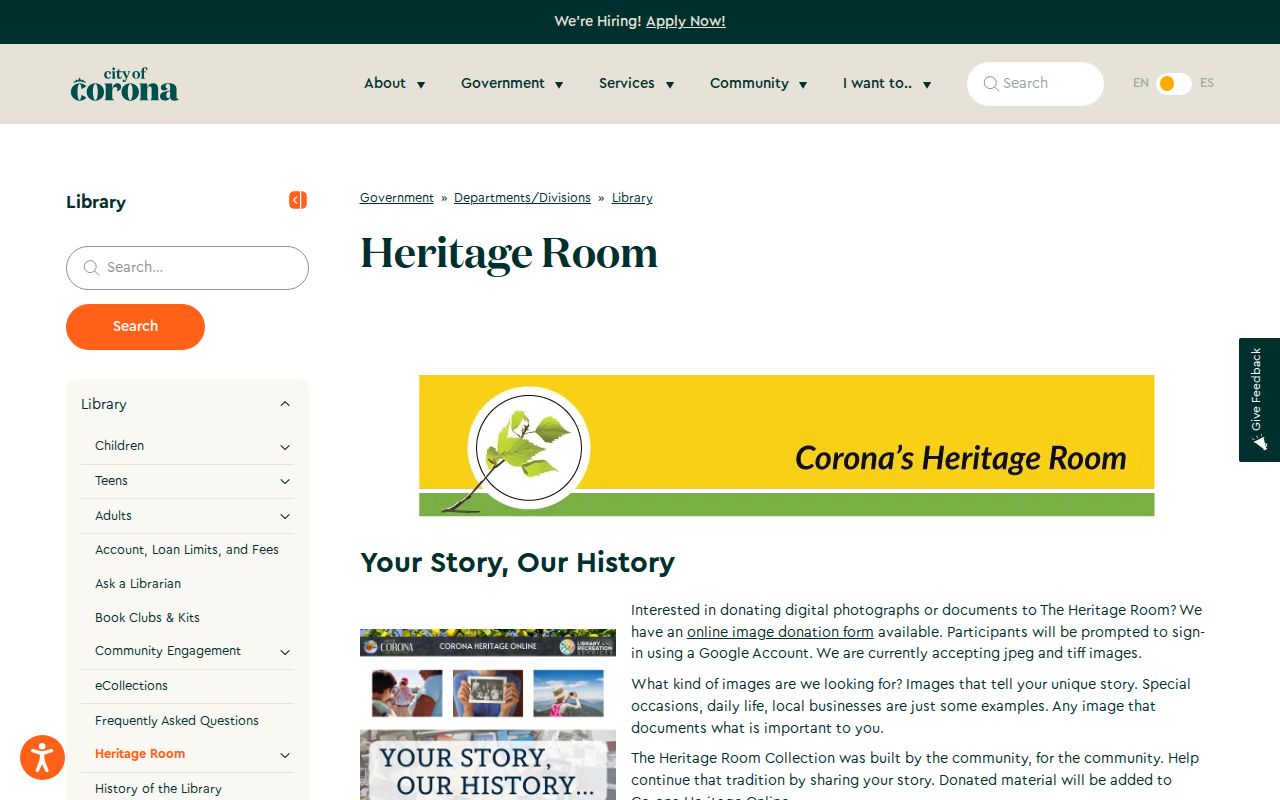
The room’s strength is context. A map, yearbook, club paper, or citrus label can place a person in a dated local setting without pretending that it is a current residence record.
For online browsing, Corona Heritage Online adds photographs, objects, and documents as digitization continues.
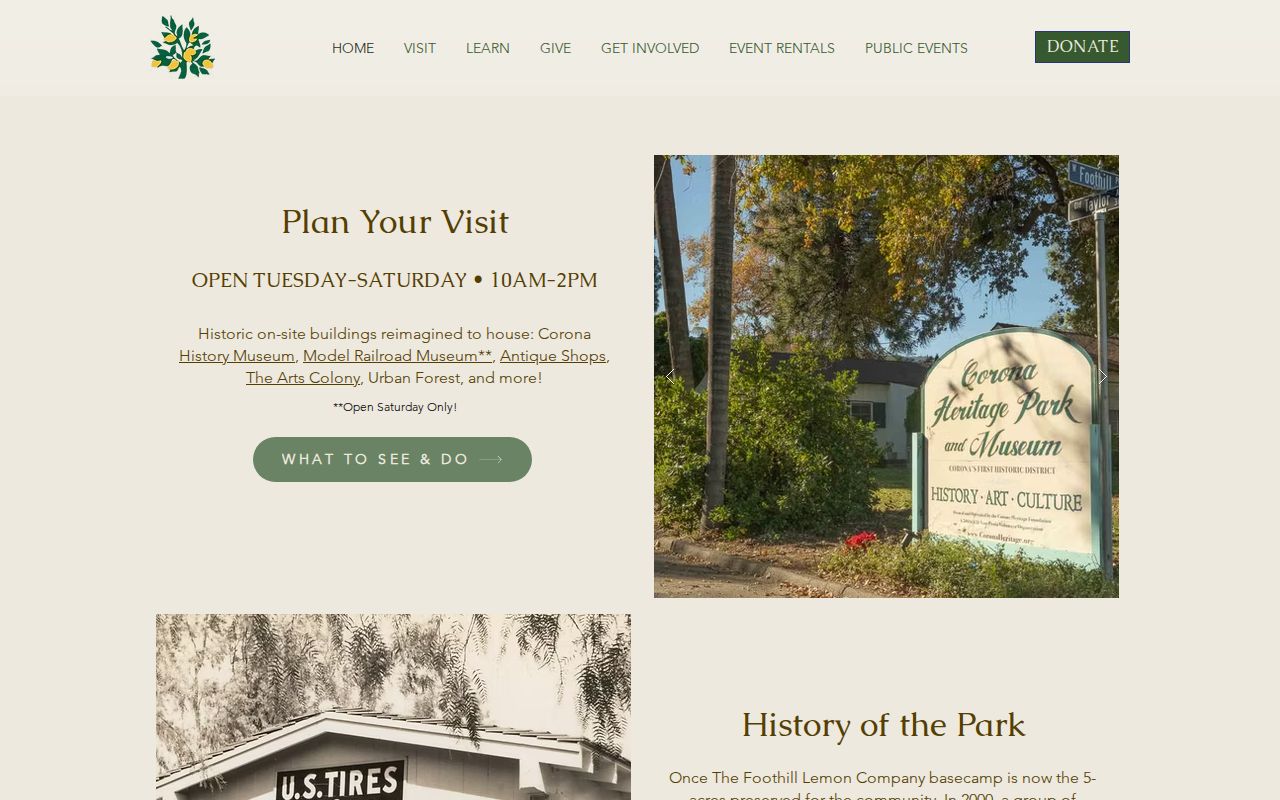
Digitized material is a lead. Confirm names and dates against the scan, title page, original collection note, or the custodian that holds the underlying record.
Official Corona Rolls vs Compiled People Data
Compiled commercial records can be fast, but they merge sources that were created for different purposes. An official index has a named custodian, a defined record role, and a path for correction or copy. A commercial compilation may lag an update, combine same-name people, or hide where a field came from. A useful comparison is not free versus paid. It is traceable source versus opaque summary.
| Question | Official Corona-area source | What to verify |
|---|---|---|
| What parcel is at an address? | Riverside ACR Property Search or Map My County | APN, situs, legal description, and city jurisdiction |
| Who signed a recorded instrument? | ACR document index and copy channel | Party role, document number, date, and legal description |
| Is a person registered? | My Voter Status self-lookup | Identity match and the purpose limits on any wider file |
| What case event occurred? | Riverside Superior Court portal or clerk | Case number, party role, docket event, and access status |
| What happened in an earlier household? | Heritage Room directories, newspapers, maps, and yearbooks | Edition, page image, date, and corroborating source |
Use the source that was built to answer the question. Preserve the URL, record number, date checked, and any limits shown on the result. That small evidence trail is more useful than an unverified list of names.
Corona’s Historical Directory Trail
Historical Corona resident directories sit in several forms. The Heritage Room holds Riverside City & County directories on microfiche for 1889–1966. It also keeps newspaper runs, death and marriage indexes, the Sunnyslope Cemetery transcription for 1895–1984, yearbooks, and organizational records. A telephone directory can supply a surname, residence marker, street, and phone number, but it may not show occupation or a household relationship. Read the title page and abbreviation key before interpreting an entry.
Local place names change the search. Corona was known as South Riverside before incorporation in 1896, and early newspapers, maps, and directories may use both names. A pre-1893 county record may fall under predecessor San Bernardino or San Diego County depending on the record and place. The 1890 federal schedules were largely destroyed, so directories, deeds, newspapers, voter material, and cemetery work often bridge that gap.
The full historical shelf, sample entries, and year-by-year method belong on the Corona city directory collections page. The central rule remains simple: a directory year shows a dated listing, not a present-day conclusion.
Corona’s Records Fallback Chain
Portals fail, older records sit outside a digital index, and some records are never open to a broad name search. The fallback is still concrete. For a city record, search the Corona request portal, then contact the City Clerk with a narrow description. For a deed, use ACR’s counter, mail, or physical index path. For a court matter, use the case number and the correct courthouse request process. For vital records, choose the county or CDPH application that matches the event and copy type. For history, ask the Heritage Room about offsite material, microfilm, and archival catalogs.
California’s Public Records Act, Government Code §§ 7920.000–7931.000, creates a presumption of access to disclosable state and local agency records. It does not require an agency to create a new list, answer a broad research question, or disclose exempt personal material. A focused request identifies an existing record, date range, department, address or APN, and format. Agencies generally make an initial determination within 10 calendar days, with a possible 14-day extension in unusual circumstances.
Some trails must end. Safe at Home substitute addresses, sealed and confidential court files, adoption records, protected voter fields, DMV personal data, and restricted vital copies have legal boundaries. A public record is for lawful personal research and civic understanding, not for stalking, harassment, or harm. When a source cannot lawfully answer the question, change the question or use a permitted family-history, property, or records-request route.
Note: Verify a result with the custodian before relying on it, and stop when a California confidentiality rule protects the person or record.
For county and state source trails, preserve the office name, portal address, date checked, and record identifier. Those details make a later correction or copy request possible.