
Corona Previous Residents: Source Eras
A backward address search works best when each record set is assigned its true time span and keeper. The Riverside County Assessor-County Clerk-Recorder document search puts recorder indexing online from January 1, 1974, while clerk documents reach back to January 1, 1893. That split is central to Corona house history. The W.D. Addison Heritage Room provides a different kind of evidence: its official Local Genealogy material lists Riverside City & County Directories from 1889 through 1966 on microfiche, along with newspapers, yearbooks, maps, and obituary files.
| Source | Years It Covers | Where Held | What It Shows |
|---|---|---|---|
| Riverside ACR recorder index | 1974 to present | ACR Web Self-Service | Named parties, document type, date, and number |
| Riverside ACR clerk index | 1893 to present | ACR Web Self-Service and clerk records | Clerk-indexed filings, including marriage-related records |
| Deed books and grantor-grantee indexes | Before 1974 | Recorder counter, microfilm, library, or archive finding aids | Earlier transfers and the legal land chain |
| Riverside City & County Directories | 1889 to 1966 | Corona Heritage Room microfiche | Address snapshots and household clues |
| Federal census | Released schedules through 1950 | NARA and library databases | Household members and dwelling context |
| Permits and code records | Coverage not published | Corona city request channels | Dated applicants, owners, contractors, and work history |
Choose the deed index for a transfer, the directory shelf for an address occupant, the census for a household snapshot, and permits or maps for a house timeline. A newspaper, obituary, or probate record can then test whether a named person stayed at the address or simply appeared in its chain.
Note: An online no-result before 1974 is a coverage clue, not proof that a deed or clerk filing never existed.
Corona Previous Residents Start With APNs
The safest starting point is the physical place, not yesterday’s surname. Search the Riverside County ACR Property Search by property address, APN, or Assessment/PIN. Then open the parcel in Map My County to check the shape, situs, jurisdiction, and nearby parcels. The county property search does not display owner names online under its current policy, but county offices provide owner identity from an address or APN on public computers or microfiche. That distinction prevents a blank online owner field from being mistaken for a missing owner.
Keep three address identities side by side. The situs is the physical location. The tax mailing address is where the notice goes and may point somewhere else. The legal description identifies the land through a subdivision, lot, map, or other recorded description. Street names and numbers can change or appear in different forms, while the APN and legal description give the deed search a steadier anchor.
- Record the APN exactly as shown by the county or map.
- Copy the legal description and subdivision, lot, or map details.
- Save the situs and mailing addresses as separate fields.
- Note the current assessment and transfer-history clues without treating them as proof of occupancy.
- Use the owner name supplied through the lawful county channel for the recorder search.
Once the parcel identity is stable, the current owner-to-deed step is clear. The full modern address chain belongs with the Corona street directory walkthrough; the backward trail begins when that parcel supplies a name and legal description for the recorder index.
Corona Deed Chain for Past Owners
Riverside ACR indexes recorded instruments by party name, so search format matters. For an individual, enter the surname first as LAST FIRST MI without punctuation. A surname plus first initial broadens the result set; exact mode preserves entered name order, while advanced or wildcard behavior helps with variants. Organization names should follow the spelling used on the recorded instrument. Date ranges and document-type filters make a large Corona result set easier to read.
| Field | Type | Required | Format or use |
|---|---|---|---|
| Name | Text | Search-dependent | Individual `Last First MI`; organization as recorded |
| Recording Date Start | Date | No | Use `mm/dd/yyyy` to narrow a deed interval |
| Recording Date End | Date | No | Use with a start date for a focused search |
| Document Types | Multi-select | No | Limit deeds, liens, releases, or other instrument groups |
| Advanced Name Searching | Checkbox | No | Broader or wildcard behavior for name variants |
| Exact or wildcard mode | Search help | No | Exact order versus broader matching |
Walk the chain in this order:
- Confirm today’s APN, legal description, situs, and owner through the parcel record.
- Find the current owner’s purchase deed and compare its legal description with the parcel, not just the party name.
- Take the seller, or grantor, and search that person as an earlier grantee to locate the seller’s acquisition.
- Repeat the comparison backward until the online recorder coverage reaches January 1, 1974.
- Move older work to physical indexes, deed books, microfilm, catalog results, or a local archive and library search.
A representative ACR index result can establish that an instrument was recorded, but the index does not make every recital true or prove that a party occupied the property. The useful fields are:
- Indexed party name and party role tied to the recorded instrument.
- Recording or document number, recording date, and document type.
- Book, page, or related references where the instrument supplies them.
- Index access to the record image or copy channel, subject to ACR charges.
- Redactions for Social Security numbers, protected information, or restricted military-discharge material.
Official images and certified copies come from ACR, with the copy channel and applicable charges rather than from a name index alone.
- Grantor
- The party transferring an interest in the recorded instrument.
- Grantee
- The party receiving that interest.
- Chain of title
- The linked sequence of recorded transfers used to follow an interest backward.
- Legal description
- The recorded land identity that can remain useful when a street label changes.
- Criss-cross directory
- An address-keyed directory that can connect a street number with an occupant or subscriber for a particular year.
- Enumeration district
- The census area assigned to an enumerator, useful when a place name or address is hard to match.
Corona's 1974 Recorder Divide
The 1974 divide changes the access plan. Riverside ACR’s public recorder index begins January 1, 1974, while clerk indexing begins January 1, 1893. Office computers at county locations cover approximately 1975 forward. The county identifies 1974 and earlier recorder records as available at Gateway Riverside, 2724 Gateway Drive, Riverside, California 92507. That is a practical counter and microfilm fallback when a name search stops at the web boundary.
Use the California State Archives for finding aids and historical state or selected local-government series, but do not assume an old Riverside County deed was transferred there. Ask archives staff which custodian holds the series. The Heritage Room and a library catalog search can help with microfilm and older finding aids. Each path answers a different question: the recorder confirms the local instrument, while an archive or library can expose the tool that leads to it.
The in-office order path uses an SST cart or order number and is often same-day unless the request needs extensive or old research. ACR says a copy costs $8 for the first page, $1 for each additional page of the same document, and $2 for certification. Online orders add a 2.15 percent card fee, and ACR reports an average 48-hour fulfillment before mailing. A mail search without a document number should include the title or type, complete party names, an estimated recording date, and a parcel number. For pre-1976 material, the office limits that search to two years after the estimated year. Mail goes to Riverside County Recorder, Attn: Certified Section, P.O. Box 751, Riverside, California 92502-0751, with a stated one to two week turnaround. The clerk-recorder phone numbers are 800-696-9144 and 951-486-7000 on weekdays from 8 a.m. to 5 p.m.
The State Archives research page illustrates the older-record fallback: it is a research doorway, not a substitute for the county deed custodian.
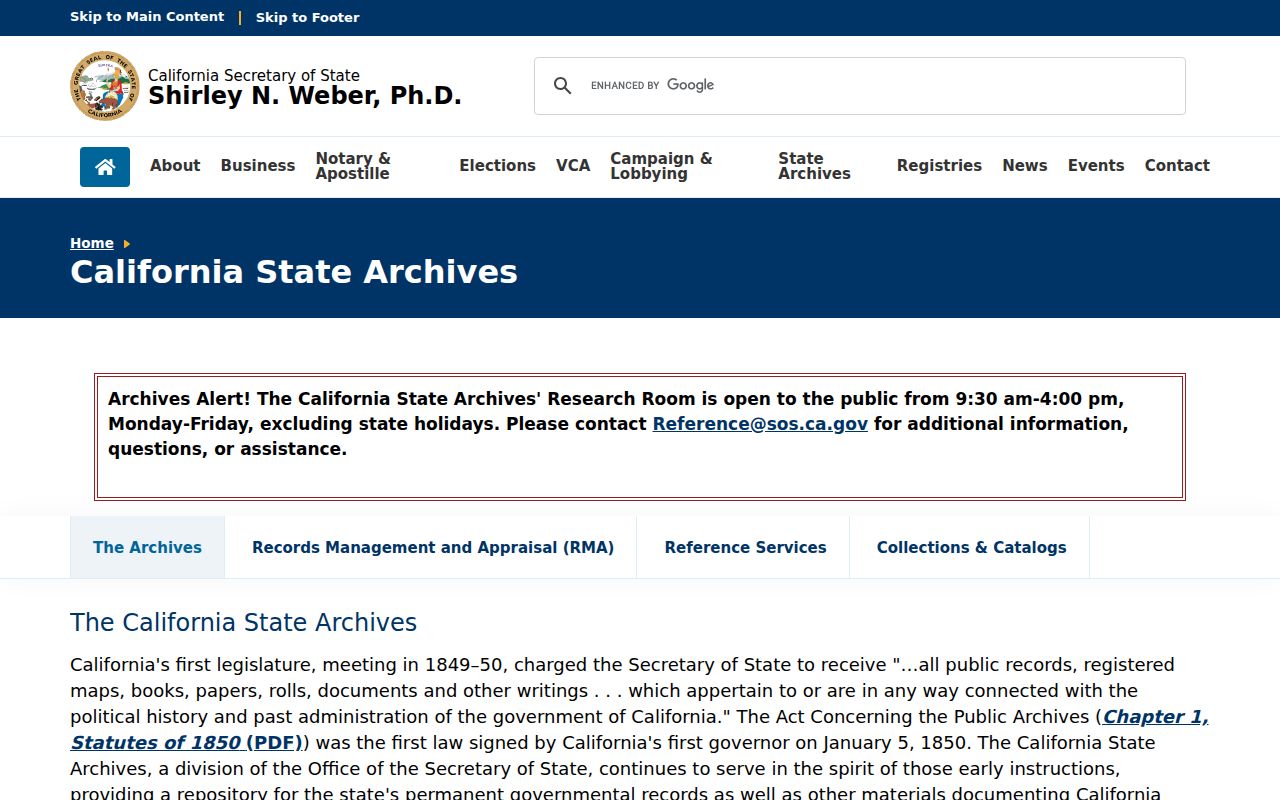
For past residents, the image belongs to the handoff from online search to finding aids, microfilm, and the office counter when the digital trail ends.
1974 is a boundary, not a dead end. A blank web result before that year calls for the counter, mail, microfilm, or archive path rather than a conclusion that no transfer occurred.
Corona Residents: Owners Versus Occupants
A deed names parties to a transfer. It does not list every person who lived at the property. An assessment parcel supplies APN, situs, value, legal description, and sometimes a mailing address. A reverse directory, city directory, or census schedule may instead capture a household or subscriber at an address for one period. The two trails can overlap, but they should stay in separate columns in a research log.
Corona’s Heritage Room is the key local bridge. Its exact documented directory resource is the Riverside City & County run from 1889 through 1966 on microfiche in the Heritage Room. The official material also names yearbooks, genealogies, newspaper microfilm, maps, manuscripts, organizational records, and an in-library Ancestry Library Edition workstation on the first floor. Exact hardcover Corona publisher runs are not published, so a catalog or staff confirmation is needed before claiming a missing year.
- Write down the current street form, APN, legal description, and any known former name.
- Choose a directory year and read the street-number entry before searching a surname.
- Match that address snapshot to the nearest released census year and its enumeration district.
- Compare the household names with deeds, permits, and newspaper notices without treating a shared surname as proof.
- Mark each result as owner, occupant, witness, applicant, or unresolved until another source supports the role.
The collections themselves are described on the Corona city directory page. Here, their value is the address-to-household bridge: a criss-cross line can suggest who lived there, while a deed explains who held the recorded interest.
Note: A different tax mailing address may be a useful contact clue, but it weakens any claim that the owner lived at the situs.
Corona Previous Residents and South Riverside
Place names matter in early Corona research. Riverside County was created in 1893 from parts of San Bernardino and San Diego counties. The community was first known as South Riverside and incorporated under the name Corona in 1896. A search limited to the modern city name can miss the address, household, or land clue you need in an 1880s or 1890s source.
The 1890 federal population schedules were largely destroyed nationally. That missing census year makes the local newspaper and directory shelf more important for previous residents. The Heritage Room identifies the South Riverside Bee from June 2, 1887 through June 20, 1896, the Corona Courier from January 6, 1900 through April 29, 1938, and the Corona Daily Independent from August 24, 1906 through April 30, 1983. It also lists later Corona-Norco Independent and selected Press-Enterprise microfilm, plus an in-library full-text Corona Newspaper Archive covering a combined 1887 through 1977 run.
The Corona Historic Preservation Society is another local history lead for buildings, neighborhoods, markers, and tours. Its material can point toward a house story or historic context, but the recorder remains the authority for a title chain.
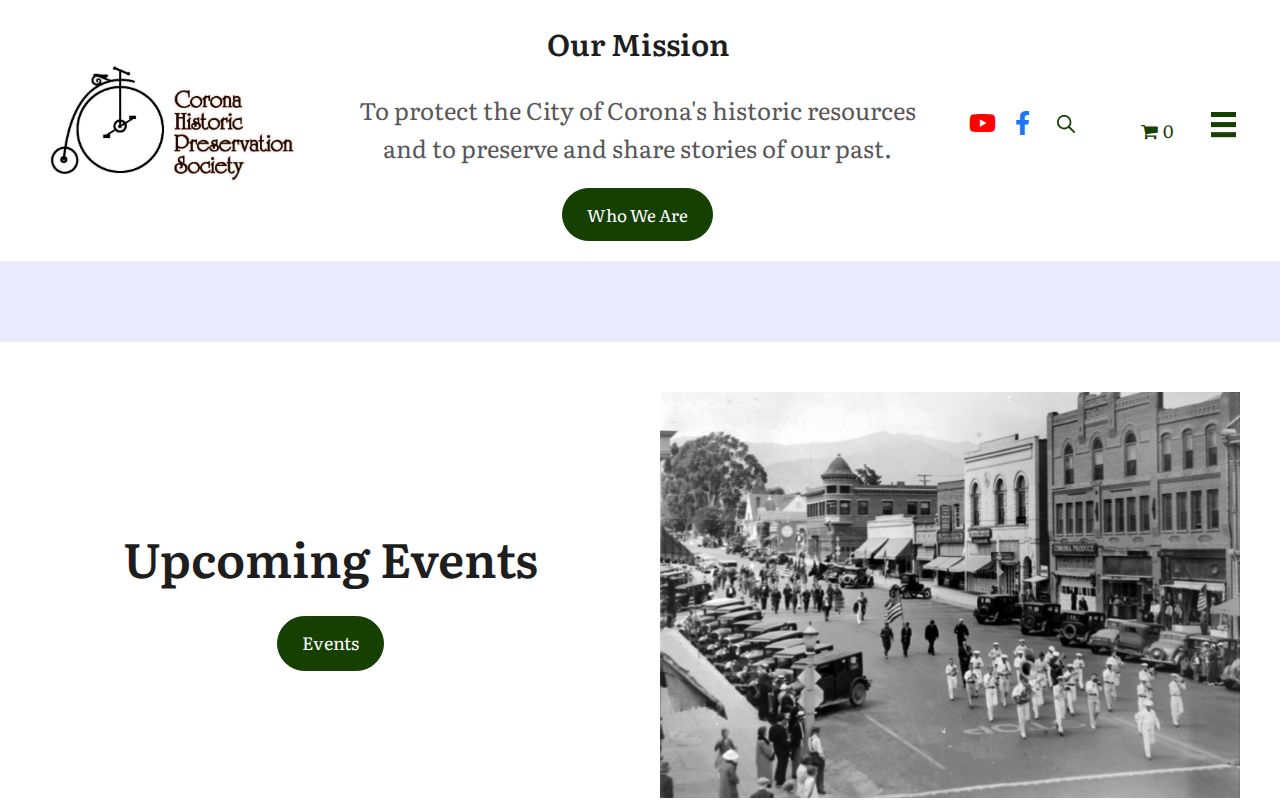
The image fits the place-name search because historic-property context can supply a street, owner, organization, or former use to test against a deed and directory entry.
Search both “South Riverside” and “Corona” in the same era. Add a street, citrus business, railroad or transportation term when the address is absent from an index. The W.D. Addison Heritage Room opened in November 1980 through community work and now keeps many non-government local collections that can bridge the 1890 gap.
Corona House History Through Maps and Permits
Maps and municipal files can date a place without pretending to name every resident. The city parcel-report schema includes Owner, Mailing Address, APN, Address, Acres, Year Built, Living Area, Bedrooms, Baths, Record Type, assessed land and improvement values, Previous APN, Community Name, Tract or Parcel Map, Lot or Parcel, Zoning or Description, General Plan, Existing Land Use, CDBG group, and Fire Severity Zone. The report separates mailing and property address and carries an informational and error disclaimer.
Use the Corona parcel-report schema as a field checklist, then request the actual city file through Corona GovQA. A focused request should name the department, date interval, address or APN, permit or case number, and desired electronic format. Public permit or code material may show a dated applicant, owner, or contractor, but a complainant or investigative detail can be withheld, and none of those roles proves occupancy.
- Use year built and improvement fields as clues about when a structure appears in the parcel record.
- Compare a previous APN or tract map with the legal description in an older deed.
- Read a permit date beside a directory year, not as a replacement for the directory.
- Check Heritage Room maps and the Library of Congress Sanborn collection when staff confirm a useful catalog item.
- Keep every map or permit citation tied to the address and APN that produced it.
Sanborn map years for a particular Corona property require a catalog check. The city-wide research does not publish a verified street-renumbering year, so older address changes should be tested against the legal description, map, directory, and deed rather than guessed.
Use the land key first. APN, legal description, and map context can keep a house history aligned when a street number or place label shifts.
Corona Past Households: Directories to Probate
After the deed chain and directory years are aligned, probate and obituary records can close a resident’s trail. The Riverside Superior Court Public Portal offers Index, Register of Actions, Calendar, Documents, and Probate Notes modes. A free account is required; a person or organization name index uses credits, while a case-number Register of Actions search is free. Public probate captions, petitions, notices, and case chronology can connect a deceased owner to an address, but the court clerk supplies files or certified copies and restricted matters do not appear as ordinary public records.
Obituaries and cemetery sources provide corroboration rather than automatic proof. The Heritage Room lists obituary clipping files from the Corona Daily Independent and Press-Enterprise, and its Sunnyslope Cemetery transcription covers burials from 1895 through 1984 with headstone inscription, birth and death dates, cause of death, and burial location. The Riverside eVitals route is the county channel for birth, death, and marriage-copy requests, subject to authorized, informational, confidential, and sealed-record rules.
The county eVitals service is a records-copy channel, not a general list of prior occupants. A successful match still needs the address, deed, directory, or probate context that explains the person’s connection to the property.
The Riverside eVitals record channel shows why a certified copy and a historical lead should be kept separate.
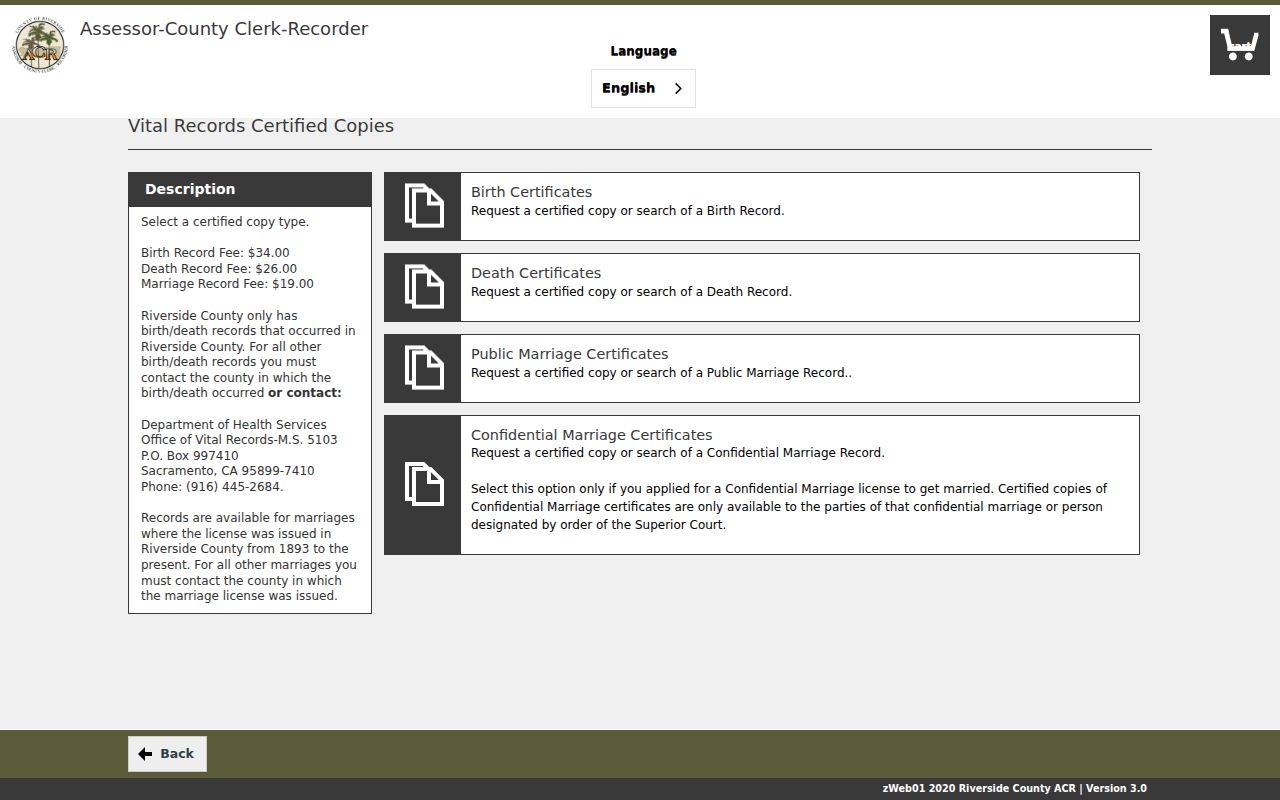
For previous residents, the image belongs at the final verification step: a vital record can confirm an event link, while the property trail supplies the address link.
Lawful personal use. Corona previous-resident research is suitable for house history, genealogy, estate work, and personal curiosity. California law does not make public records permission to stalk, harass, or intimidate a living person.