
Start a Corona Resident Search
Sorting the question by record type saves hours. A street clue points to parcel and GIS tools. An older household points to directories, newspapers, deeds, and census pages. A current name might run through a business filing, a court index, a professional license, or an authenticated voter-status check. Riverside County ACR bundles assessor, recorder, and county-clerk work. Corona City Clerk handles municipal records, while Riverside Superior Court keeps the case files. The Corona Public Library offers different evidence entirely, connecting a name to a school, club, business, or old neighborhood map.
No single source is a complete resident list. A property record shows an owner, parcel, mailing address, and legal description, yet it misses renters and other household members. A voter tool checks one identity, not a whole street. A directory entry is a dated clue rather than proof of today's residence. Start from the most stable fact. Save the APN or record number. Then test the first result against a second source.
- Use the Riverside property search or Map My County to turn a street address into an APN, situs address, and legal description.
- Search the ACR recorded-document index by party name, date, and document type, using the surname-first format when the portal calls for it.
- Use California My Voter Status only for an identity-matched self-lookup, or review the qualified-purpose file rules before seeking voter data.
- Check the Riverside court index, business and license records, or vital-copy channel when the question concerns one person or one event.
- For earlier residents, ask the Heritage Room for the right directory, microfilm, map, yearbook, or newspaper run, then compare the dated clue with a deed or obituary.
Where Corona Resident Records Live
Corona is an incorporated city inside Riverside County, not a separate records jurisdiction. Corona City Clerk handles municipal records. Council, planning, permit, administrative, and police files start there. Riverside County ACR keeps deeds, assessments, marriages, fictitious business names, and most county vital-copy channels. Case files belong to Riverside County Superior Court. The California Department of Public Health is the state vital-record custodian. A request to the wrong desk can spell trouble. A simple Corona records search turns into a dead end.
Riverside County ACR
Recorder, assessor, and county-clerk services
800-696-9144
951-486-7000
Corona City Clerk
400 S. Vicentia Avenue, Suite 115
Corona, CA 92882
951-736-2201
City records and California Public Records Act requests
Riverside Superior Court
Countywide case index, registers of action, and courthouse files
Corona Courthouse: 505 S. Buena Vista Avenue
Corona Public Library
650 S. Main Street
Corona, CA 92882
951-736-2381
W.D. Addison Heritage Room and local-history collections
Corona Property Search Starts With a Parcel
An address question in Corona begins with the Riverside County ACR Property Search. The tool accepts a property address, an APN, or an Assessment/PIN. The online card can return the parcel number, situs address, legal description, property type, acreage, assessed land and improvement values, and transfer history. That is a lot of detail. One thing is missing. County policy keeps owner names off the online display, so the web result is not a complete owner directory. Public computers and office records still give owner identity from an address or APN.
Situs, mailing address, and legal description mean different things. Situs is the physical location. The mailing address is where a tax notice goes. The legal description is the stable land identity when a street name or number changes. Treat the property portal as a bridge. With the parcel known, search the recorded-document index for the named party, then compare the deed's legal description against the parcel.
| Portal field | Type | What it does | Limit |
|---|---|---|---|
| Property Address | Text | Finds a parcel from a street number and name | Normalize directionals and street suffixes |
| APN | Text | Finds the county assessment parcel | Use the digits shown by GIS or a tax record |
| Assessment/PIN | Text | Uses the county assessment identifier | Enter the first nine digits without the dash/check digit |
| Results | Parcel list | Opens a parcel card and related property details | Online owner identity is not displayed |
The Riverside County ACR office site presents the county property, recorder, and clerk functions in one place. Corona parcel and deed work starts there.
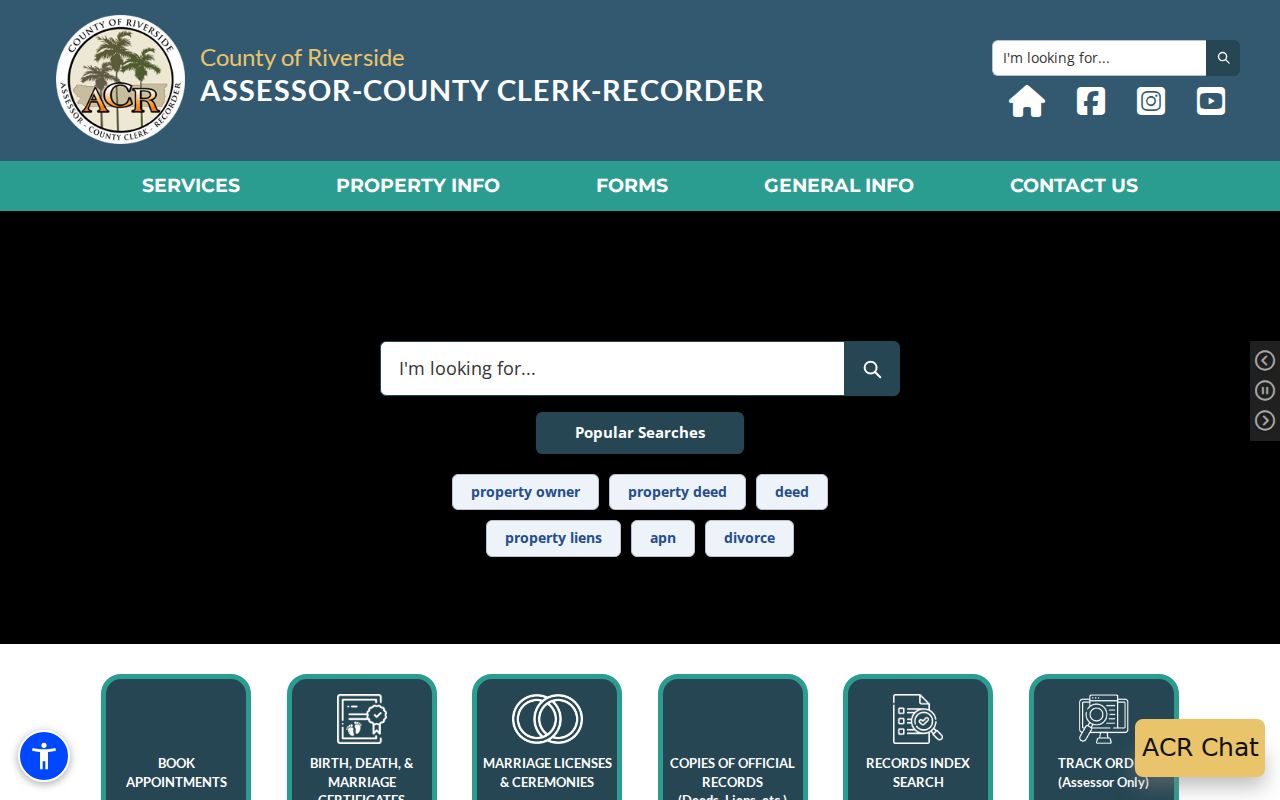
County ACR is the custodian connection for Corona parcels, recorded documents, and clerk records. City Hall keeps only the municipal side.
- Parcel
- A county assessment unit identified by an APN, not a list of all people at an address.
- Situs address
- The physical property location, which may differ from the tax mailing address.
- Legal description
- The deed language that identifies the land by lot, subdivision, map, or metes and bounds.
- Index
- A finding aid for a recorded instrument; it is not the certified image or the full file.
Riverside’s 1974 Corona Deed Divide
The recorder's online index starts January 1, 1974. The county-clerk index reaches back to January 1, 1893, when Riverside County was formed. Those coverage lines differ. Stopping at 1974 proves nothing about earlier deeds. For older land research, use the recorder counter, physical grantor-grantee books, microfilm, or FamilySearch and library guidance. The Gateway Riverside office is the county's stated home for 1974-and-earlier recorder work.
The index wants names a certain way. An individual goes in LAST FIRST MI order without punctuation, while an organization is searched as recorded. Exact mode preserves the entered order. Advanced searching broadens variants with wildcard and sounds-like tools. A typical result names the indexed parties and roles, the recording date, document number, document type, and sometimes book/page references. It proves an instrument was recorded, not that the person lived there or that every statement holds true.
Copies carry set fees. ACR lists $8 for the first page, $1 for each additional page of the same document, and $2 for certification. Online card orders add a 2.15% fee. In-office requests may be same day. Mail searches without a document number want complete party names, title or type, estimated date, and parcel number. Pre-1976 mail requests are limited to two years around the estimated date, with a stated one-to-two-week turnaround.
Note: A no-result before 1974 is a prompt to change channels, not evidence that the property had no earlier owner.
The Riverside ACR document search starts a deed trail.
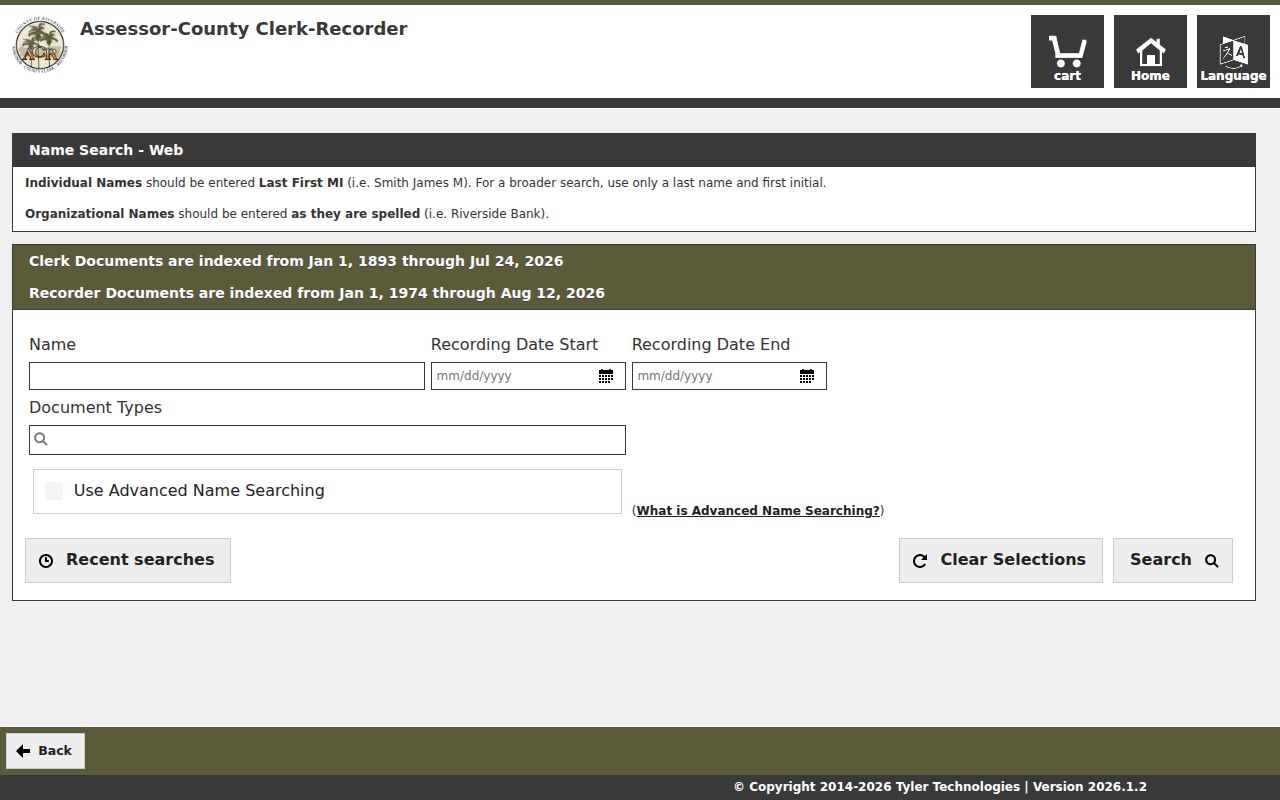
That screen opens a deed or lien trail. Use the document number to request the official image or certified copy from ACR.
Current Resident Sources for Corona
Clues about current Corona residents sit in records that each mean something different. A property roll names the parcel and its assessed owner. The recorder connects a name to a deed or other instrument. A voter status result belongs to one person. It belongs to whoever clears the identity match. It does not belong to a browser. City records can point to an applicant, contractor, complainant, or responsible party. That party may not live there at all. Business and professional-license files carry a public address of record. Weigh the record's role as carefully as the name itself.
| Source | What it can show | Keeper | Access |
|---|---|---|---|
| Property parcel | APN, situs, values, characteristics, and possible office-only owner identity | Riverside ACR | Address/APN search; informational |
| Recorded-document index | Parties, role, instrument type, date, and document number | Riverside ACR | Free index; copy fees apply |
| Voter status | Authenticated registration status, address, party, polling, and ballot details | California Secretary of State | Self-lookup only |
| Business or license record | Entity, license status, agent, filing address, or public discipline | State and city custodians | Public search; detail varies |
| City record | Permit, planning, police, council, or administrative participant | Corona City Clerk | Portal, counter, or request |
Not every question needs the whole Corona residents directory. Sometimes one record settles it. A resident lookup works best when a name needs to be matched to a single entry. A street search works differently. Anchor it to the parcel first. From there, branch into the deed or the address record that answers the actual question.
California Voter Lookup for Corona
California offers My Voter Status as a self-service tool. It is private, not a browse. You supply a first name, last name, and full date of birth, plus one of three identifiers: a California driver license or ID match, the last four digits of a Social Security number, or the stated no-identifier choice. A match returns registration status and address, party and language preference, polling place, upcoming-election details, ballot status, and county contact information.
Nothing here resembles a Corona residents directory. The tool is not a public name list and not a by-street browse. Broader voter-file access exists, but only for election, scholarly, journalistic, political, or governmental purposes. The state charges a $100 fee for the statewide application. Individual voter requests cost $30 each within stated maximums. Elections Code §§ 2188 and 2194, the related regulations, and the application attestations govern the file. Confidential voters and protected identifiers stay suppressed.
- Identity fields
- First name, last name, full date of birth, and a qualifying ID or last-four SSN path.
- Self-lookup output
- Status, registration address, party preference, polling place, ballot status, and county contact.
- Approved file fields
- Name, DOB, registration date, address, precinct, contact information, and party preference, subject to law.
- Excluded identifiers
- Driver license or state ID number, last-four SSN, unique identifier, signature image, and confidential records.
California My Voter Status confirms an authenticated user's registration details. It does not turn the Corona voter roll into an open resident directory.
The identity step is visible in the California My Voter Status source capture.
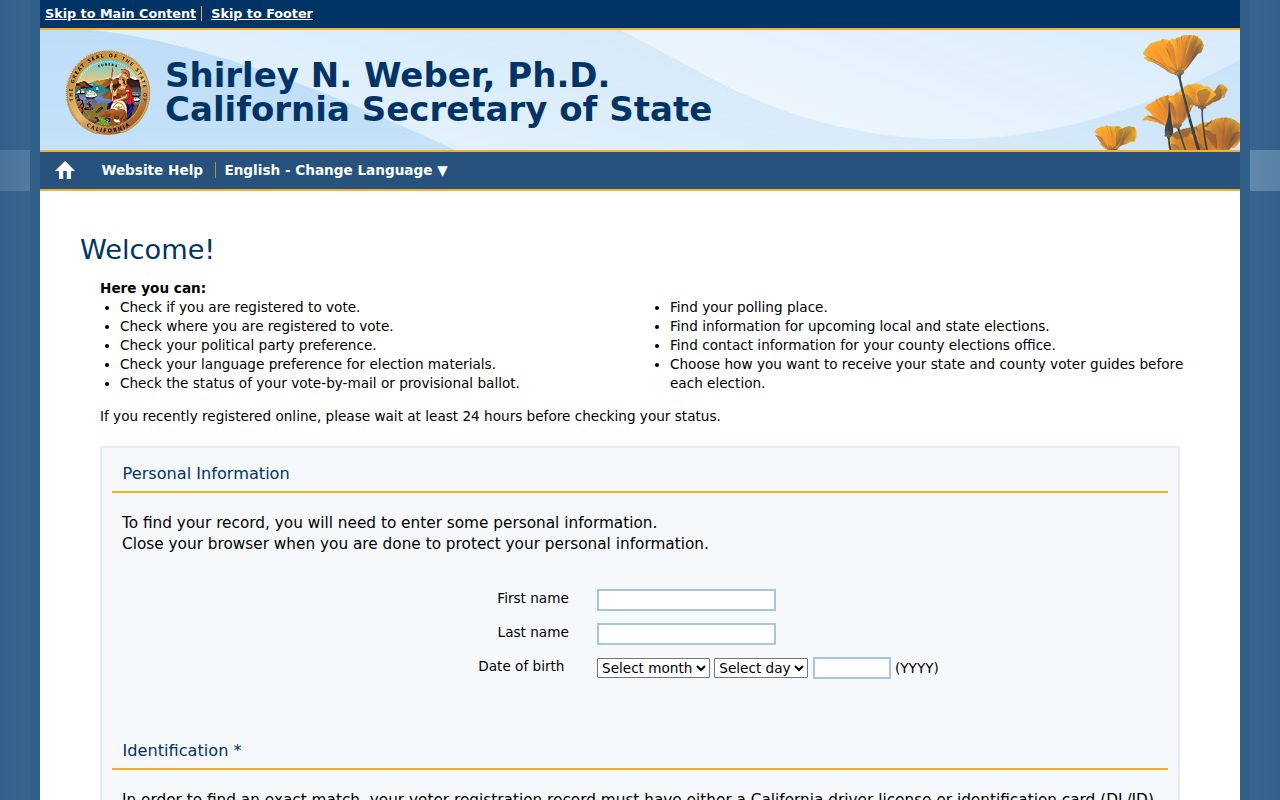
The form really serves one person checking a personal registration. That design choice matters. It should never be mistaken for a casual Corona name list.
Corona ZIP Geography Can Mislead
Corona's mailing geography sprawls past any clean city line. The official GIS layer counts six Census ZCTAs: 92503, 92879, 92880, 92881, 92882, and 92883, with 92878 added locally. ZIP 92877 belongs to the Citrus post office and lacks a Census polygon in that layer. Down south, 92883 also carries Temescal Valley addresses that can fall outside incorporated Corona. A postal label alone proves nothing about jurisdiction.
Verify delivery through USPS first. Then check incorporated-city status with Riverside County GIS. A property record may list a situs ZIP, a mailing ZIP, an APN, or a legal description. Those fields often disagree without any error. When a name search surfaces several nearby jurisdictions, compare the parcel against the city boundary before asking Corona for a record that rightly belongs to Riverside, Norco, or an unincorporated pocket.
- 92877
- Corona and Citrus post-office designation; it has no Census polygon in the reviewed layer, so verify delivery use with USPS.
- 92878 and 92879
- North, northwest, and east-central Corona areas that need parcel checks near Riverside and Norco edges.
- 92880
- West and northwest growth geography; older records may retain the ZIP after the 2020 delivery change.
- 92881 and 92882
- South, east, central, west, and southwest areas where parcel jurisdiction resolves close boundaries.
- 92883
- Far-south Corona postal geography and Temescal Valley, where a Corona mailing label may sit outside city limits.
For the mapped layer behind these distinctions, open Riverside Map My County and inspect the parcel rather than treating a ZIP as a resident list.
Riverside Court Records for a Corona Name
Corona cases principally run through the Superior Court of California, County of Riverside. The public portal splits its tools into Index, Register of Actions, Calendar, and Documents modes. Probate Notes sits alongside them. A free account is required. Name and organization searches use credits. Case-number lookups and the Register of Actions cost nothing. A hit gives a party name, role, case number, chronology, and sometimes a disposition. A shared surname proves nothing about identity. Compare the middle initial, the city, and the timeline. Check the age or birth date where lawfully visible, and any business or parcel ties, before drawing conclusions. A dismissal, acquittal, sealing status, or restricted case type shifts what any result means. Corona civil coverage starts in March 1994 and small claims in November 1994. Family and probate coverage each have their own published ranges. The courthouse clerk remains the source for certified copies and older or restricted files.
- Index: person or organization name search, with one credit per search
- Register of Actions: case-number events and docket chronology
- Calendar: current and future hearings up to seven days
- Documents: case-number access where remote viewing is allowed, with fees or limits that vary
- Probate Notes: hearing notes posted on the court's timing schedule
Treat a court result as one dated piece of a resident lookup. It does not replace a file request. Nor does it establish that a party lived at the address in the caption.
Corona Vital Records and Copy Types
California vital records draw a sharper line than a simple public-versus-closed label. An authorized certified copy can establish identity. But it goes only to a requester who fits the statutory category and sworn-statement rules. An informational certified copy carries a marking that it is not valid for identity. It is available more broadly unless the record is confidential or sealed. Confidential marriage copies go only to a party or by court order under Family Code § 509. Adoption and amended records carry separate restrictions. The CDPH vital-record application hub identifies the state channel. Riverside ACR handles county events and local marriage records. Effective January 1, 2026, CDPH lists $31 for birth, $26 for death, $19 for marriage, and $18 for a dissolution certificate. Riverside ACR lists county birth at $34. Death is $26, public marriage is $19, and confidential marriage is $19. A search fee can still be due when no record turns up.
Expect application fields to cover applicant contact details. They also cover the registrant or decedent name, event date and place, parents' names, relationship, purpose, copy type, a signature, and a sworn eligibility statement. Go to the county or state custodian for the event and copy type rather than hoping for a complete current name index.
Note: The state application hub also explains the forms and instructions before a copy request is mailed.
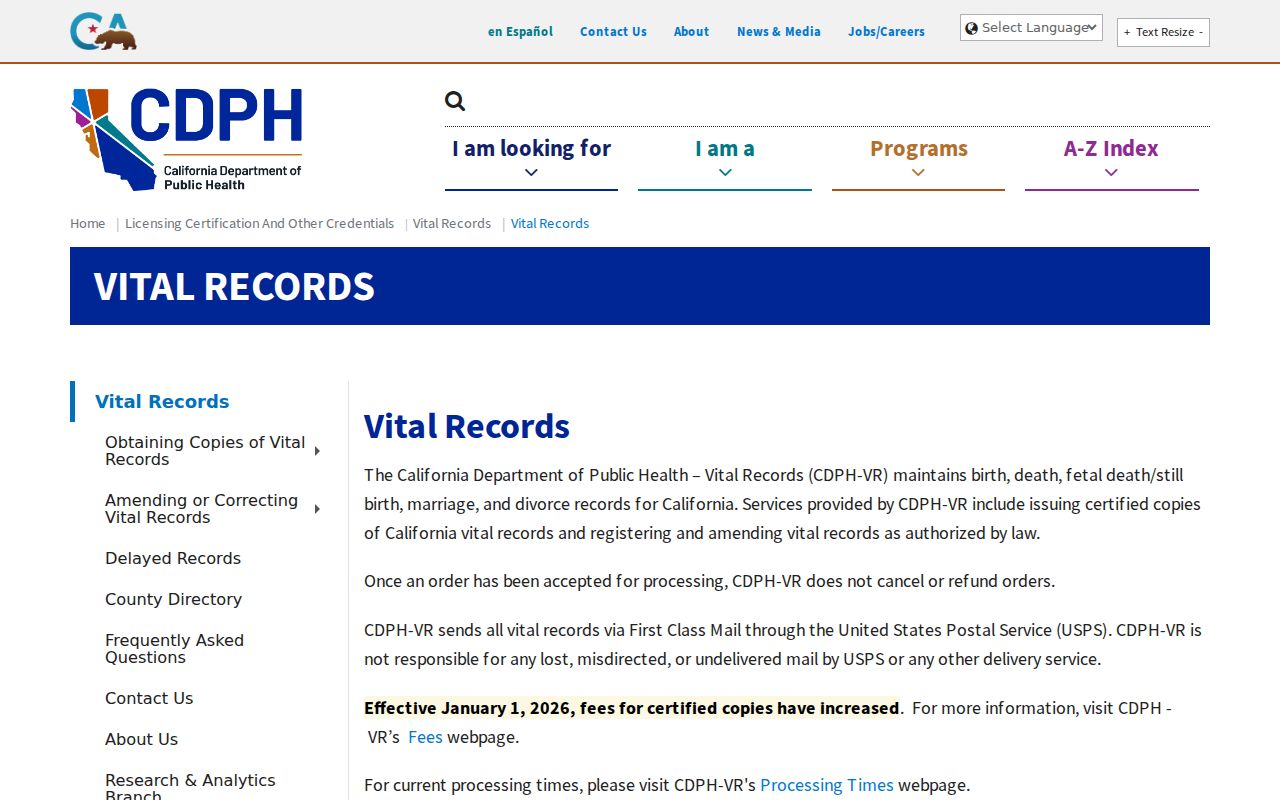
Eligibility and copy type drive access on the application screen. No blanket age threshold governs every California record.
Corona City Clerk Public Records
The Corona City Clerk serves as the record keeper for city government. Council proceedings, municipal-code material, and official city documents are custodied there. So are claims, campaign and FPPC filings, public notices, and the records-management program. The city's CPRA portal splits requests two ways. One track covers City Records. The other covers Police Department or Animal Services records. A knowledge base, a public request archive, and account tracking sit alongside it. Before filing anything, search the linked building, business-license, council, public-hearing, and Planning Commission resources.
A sharp request speeds everything up. Name the department and the date interval. Add an address or APN, any permit or case number, and your preferred electronic format. City records can surface an applicant, owner, contractor, complainant, or other responsible party. They cannot prove anyone actually lived at a property. Police reports may hold confidential complainant, victim, juvenile, or investigative details. Releasable traffic reports run $0.25 per page. A local verification or clearance letter costs $27.
Start with the Corona City Clerk public-records page for anything involving city government. Vital records take a different path. Marriage, birth, and death certificates belong to Riverside County ACR. Fictitious business names and document recording do too. Traffic, small claims, and criminal matters go to Riverside Superior Court instead. The city request page remains the entry point, archive, and tracking path for municipal records.
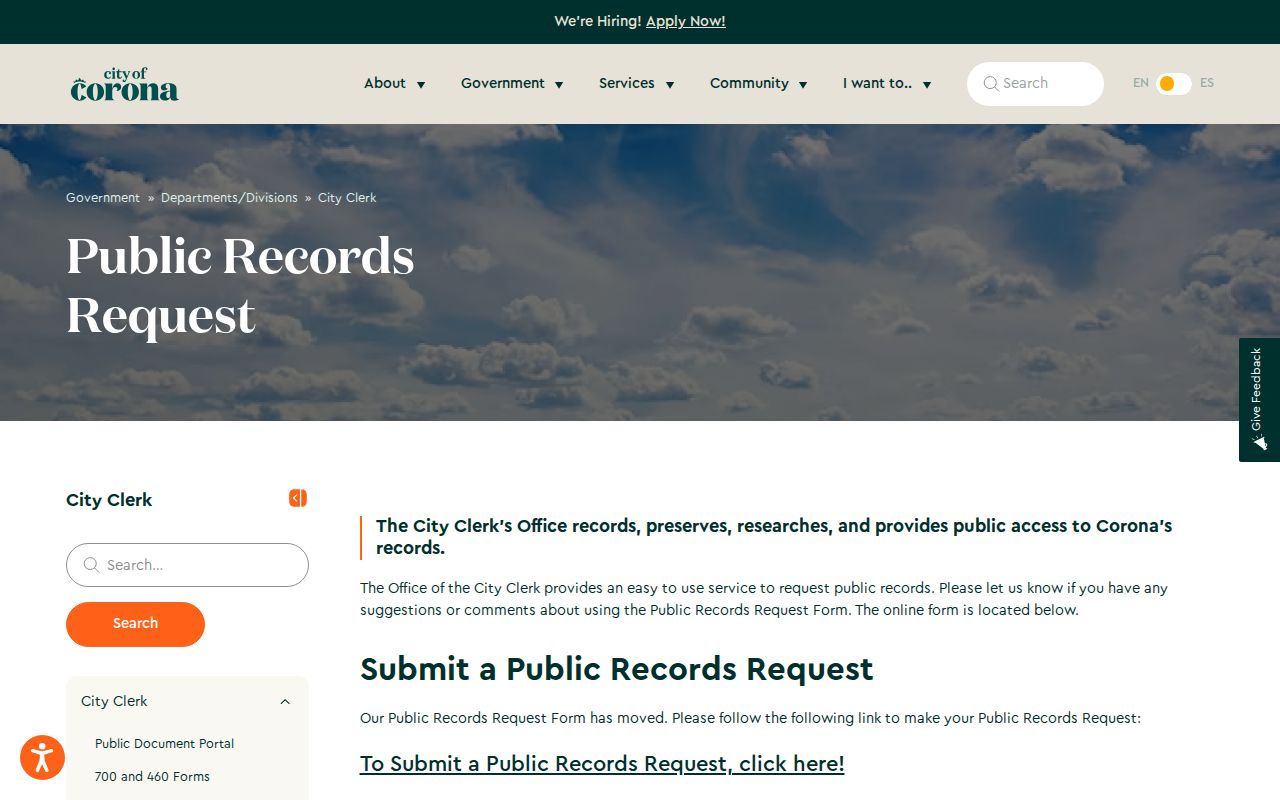
The portal handles requests and tracking. It is not a ready-made Corona resident roll, so search the right department before asking staff to find an existing record.
Corona Heritage Room Resident Clues
The W.D. Addison Heritage Room fills the gap when a current database cannot explain an older Corona name or address. Its shelves hold photographs, slides, genealogies, books, manuscripts, yearbooks, maps, citrus labels, business and club records, church records, letters, diaries, ephemera, and newspaper microfilm. Roughly 6,000 digitized items live in Corona Heritage Online. Search by surname, street, business, school, subdivision, or organization. Then ask the staff about material still waiting to be digitized.
Plan around the room's rules. Some holdings sit offsite, so request them ahead of your visit. Closed-hour research appointments run Tuesday through Thursday with at least one week's notice. Copying, scanning, and photography require staff permission. The Memory Lab offers a planetary scanner plus microfilm, fiche, VHS, DVD, and reel-to-reel equipment; bring a flash drive and follow staff instruction. Check the W.D. Addison Heritage Room source before you go.
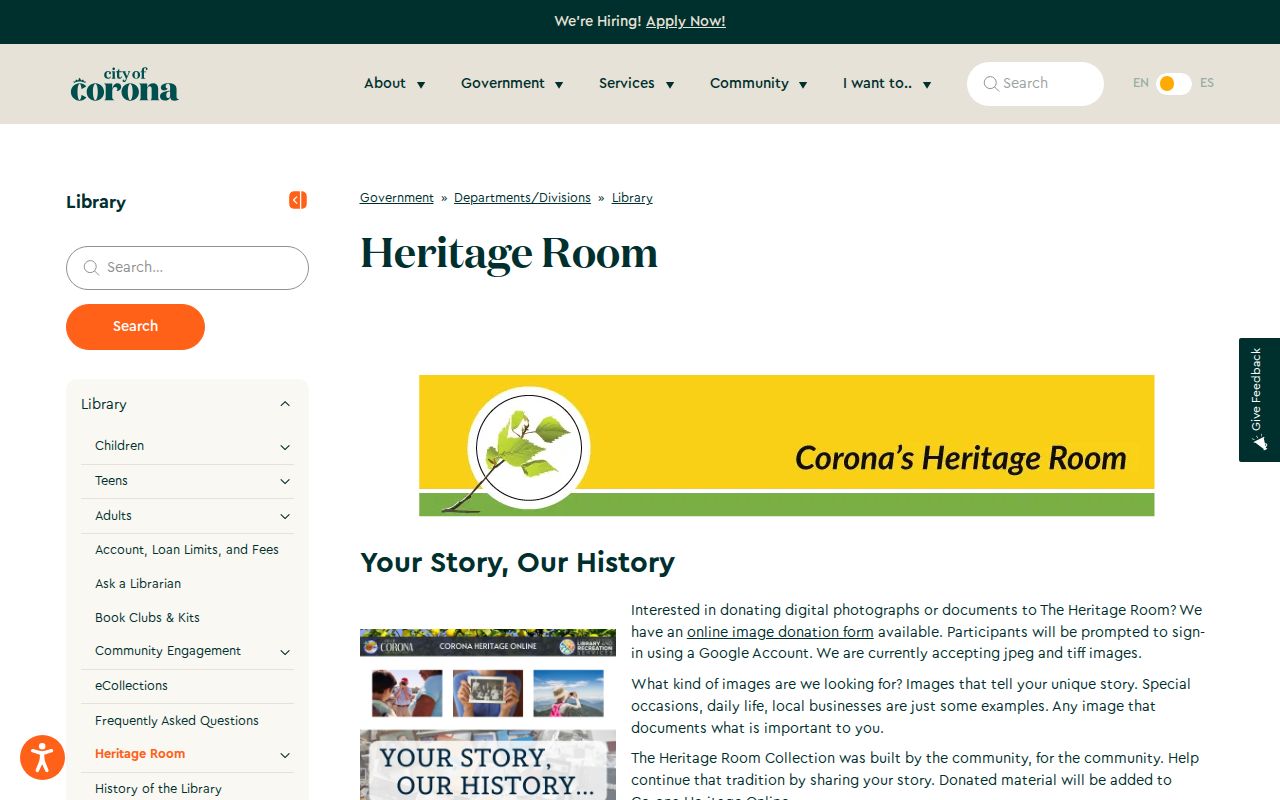
Context is the room's real strength. A yearbook, club paper, map, or citrus label can place a person in a dated local setting without masquerading as a current residence record. For browsing from home, Corona Heritage Online keeps adding photographs, objects, and documents as digitization continues.
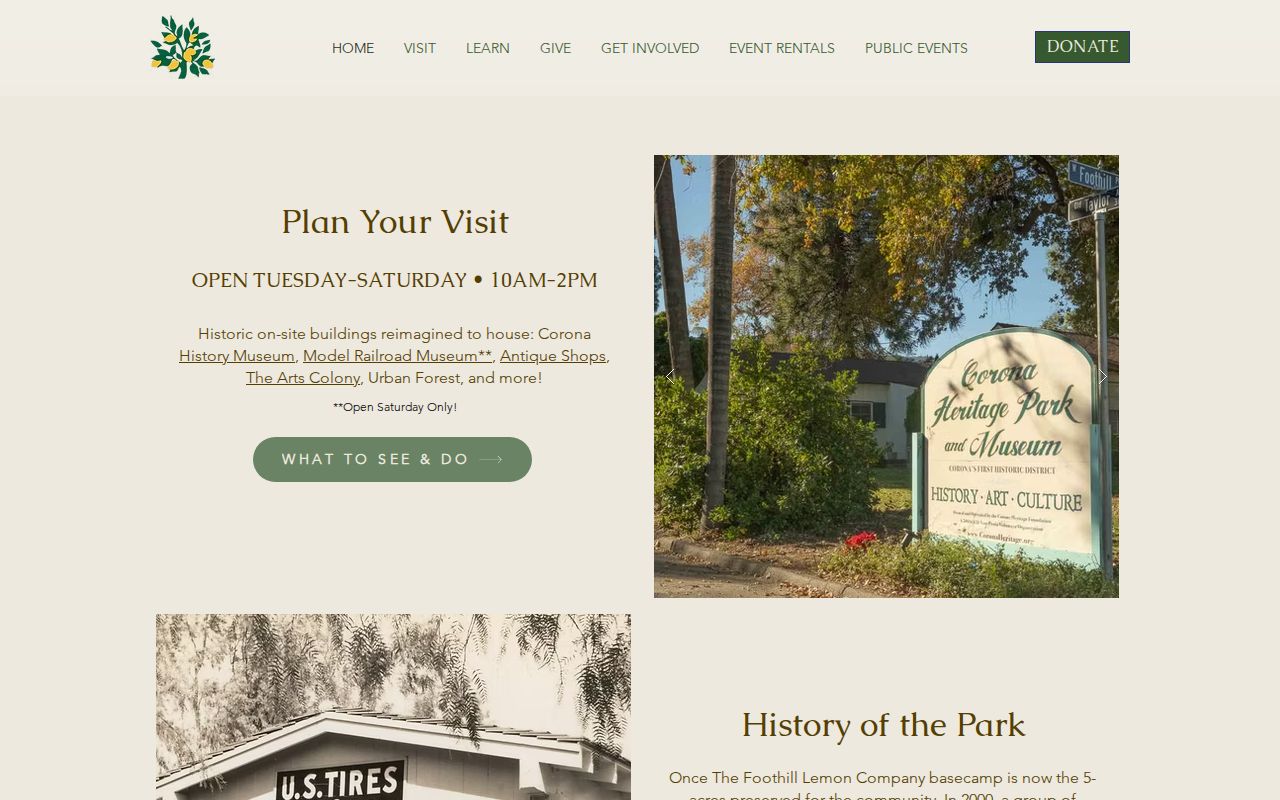
Treat digitized material as a lead, not a verdict. Confirm names and dates against the scan, the title page, the original collection note, or the custodian holding the underlying record.
Official Corona Rolls vs Compiled People Data
Commercial compilations are fast. They merge sources built for different purposes, though. An official Corona index has a named custodian. It carries a defined record role and a correction path. A compiled file may lag an update, blend same-name people, or hide a field's origin. The real comparison is traceable source versus opaque summary, not free versus paid.
| Question | Official Corona-area source | What to verify |
|---|---|---|
| What parcel is at an address? | Riverside ACR Property Search or Map My County | APN, situs, legal description, and city jurisdiction |
| Who signed a recorded instrument? | ACR document index and copy channel | Party role, document number, date, and legal description |
| Is a person registered? | My Voter Status self-lookup | Identity match and the purpose limits on any wider file |
| What case event occurred? | Riverside Superior Court portal or clerk | Case number, party role, docket event, and access status |
| What happened in an earlier household? | Heritage Room directories, newspapers, maps, and yearbooks | Edition, page image, date, and corroborating source |
Match the source to the question. Save the URL, record number, date checked, and any limits on the result. That small evidence trail beats an unverified list of names.
Corona’s Historical Directory Trail
Corona's historical resident directories survive in several forms. The Heritage Room keeps Riverside City & County directories on microfiche covering 1889 through 1966. Newspaper runs, death and marriage indexes, the Sunnyslope Cemetery transcription for 1895–1984, yearbooks, and organizational records round out the shelf. A telephone directory can yield a surname, residence marker, street, and phone number. It may say nothing about occupation or household relationships. Always read the title page and abbreviation key first.
Place names complicate the hunt. Corona was called South Riverside before its 1896 incorporation. Early newspapers, maps, and directories may use either name. A pre-1893 county record might sit under predecessor San Bernardino or San Diego County. It depends on the record and place. The 1890 federal schedules were largely destroyed. Directories, deeds, newspapers, voter material, and cemetery records often bridge that missing year.
The full historical shelf, sample entries, and a year-by-year method appear on the Corona city directory collections page. One rule stays constant. A directory year shows a dated listing, never a present-day conclusion.
Corona’s Records Fallback Chain
Every Corona lookup eventually hits friction. Portals go down. Older entries sit outside any digital index. Some records never open to a broad name search. The fallback chain still works. A city record starts with the Corona request portal. A narrow description sent to the City Clerk covers what the portal misses. A deed runs through the ACR counter, mail, or the physical index. Court files need the case number and the right courthouse request process. Vital records depend on matching the county or CDPH application to the event and copy type. For local history, the Heritage Room can pull offsite material, microfilm, and archival catalogs.
California law tilts toward access. The Public Records Act, Government Code §§ 7920.000–7931.000, presumes that disclosable state and local agency records are open. But it never forces an agency to build a new list. It will not answer a sprawling research question. Nor will it hand over exempt personal material. A focused records request names the existing record. It also names the date range, the department, an address or APN, and a format. Agencies make an initial determination within 10 calendar days. Unusual circumstances can add a 14-day extension.
Some trails end where the law says they must. Safe at Home substitute addresses carry firm boundaries. Sealed and confidential court files, adoption records, protected voter fields, DMV personal data, and restricted vital copies do too. Treat any public record as material for lawful personal research and civic understanding, never for stalking, harassment, or harm. When a source cannot lawfully answer the question, change the question. Or take a permitted family-history, property, or records-request route instead.
Note: Verify a result with the custodian before relying on it, and stop when a California confidentiality rule protects the person or record.
Good records habits pay off across the Corona residents directory. For every county or state source trail, keep the office name, portal address, date checked, and record identifier. Those details are what make a later correction or copy request possible.